Residential Cleaning Pricing Engine
Stop guessing what to charge for house cleaning.
Walk a home one time. Leave knowing what to charge, how many crew hours the job should take, and whether that price still works at your target hourly rate.
See the pricing system in actionFollow one home from room inventory to price, crew hours, and job economics.
No account required. About three minutes.
The moment this is about
She is standing in the kitchen waiting for a number.
You have already walked the house. You counted the bedrooms. You noticed the third one is a guest room nobody has slept in since Christmas. You noticed the hard water on the master shower door, the dog hair worked into the baseboards, the grease film on the range hood.
Now she is looking at you, and you are doing arithmetic in your head while trying to hold eye contact.
So you say a number. She says that sounds fine. And then you drive home and spend the next twenty minutes wondering whether you just gave away a hundred dollars a month for the next two years.
That is the part nobody warns you about. The quote is over in four seconds. The doubt lasts all week.
- Did I charge enough for everything I just saw?
- Is this first clean going to eat the profit from the whole day?
- Can my crew actually finish inside the hours I just committed to?
- Did I price myself out of a customer I would have kept for three years?
- What am I actually basing this number on?
- If I hire a manager tomorrow, how do I teach her to do this?
You do know how to price. What you do not have is any way to check yourself.
That is the real gap. Not knowledge. Verification. When a job goes badly you cannot tell whether the estimate was wrong, the crew was slow, the house was unusual, the first clean was worse than it looked, or the discount you offered quietly took the job below water. All five feel identical afterward.
What the guess costs
A pricing mistake does not stay a pricing mistake.
Run these at your own target rate. We use $65 per goal labor hour because that is the default the tool ships with.
One recurring customer, priced 45 minutes light
Not a disaster. Not even something you would notice. Forty five minutes of crew labor you never charged for, on a home you will clean every other week for years.
$1,268 a yearONE CUSTOMER. 26 CLEANS.Ten of them, because the method never changed
You did not make ten different mistakes. You made the same one ten times, because there was nothing in the process to catch it.
$12,675 a yearTHE SAME BLIND SPOT, REPEATEDOne first clean that runs three crew hours long
Work you performed and did not bill. Plus a crew that got beaten up on a house they were told would take five hours, and now trusts your numbers a little less than they did that morning.
$195 given awayPLUS THE PART YOU CANNOT PUT A NUMBER ONAnd then there is the cost you can never measure, because the customer who thought your quote was too high does not call back to explain why.
When pricing lives in your head, a crew problem and a pricing problem look exactly the same.
Why the shortcuts fail
Both of these are three bed, two bath.
Type them into any bedroom and bathroom calculator and you will get two prices within a few dollars of each other.
- 1,600 sq ft
- 3 bedrooms total, 2 in regular use
- 2 bathrooms total, 1 in regular use
- No first clean conditions
$357 / 5h 20m goal
- 2,800 sq ft
- 3 bedrooms total, all in regular use
- 2 bathrooms total, both in regular use
- Pet impact, hard water, heavy grease, clutter
$579 / 8h 40m goal
Actual Price Every Clean output. Same headline room count, different work.
A regularly used bedroom is not a guest bedroom. A maintained kitchen is not a kitchen with grease baked into the hood. A den, an office, a laundry room, a sunroom and a finished basement do not stop existing because a calculator has nowhere to enter them.
The calculator cannot see the difference. Your crew will, for the entire first clean.
Where this came from
We did not set out to build software. We were trying to fix our own pricing.
We run a residential cleaning company in North Carolina. Everything below happened because we had the same problem you have, and it was costing us money.
We bought the other calculators first
Most of them wanted bedrooms, bathrooms, square footage, and maybe a general dirtiness level. That is fast. It is also silent about where the labor actually goes. Two homes can carry the same headline numbers and need meaningfully different amounts of work, and none of those tools had any way to say so.
So we overbuilt it, and that was worse
We swung the other way. Walk time. Room engagement percentages. Layered difficulty factors and cofactors. On paper it looked serious.
In an actual walkthrough it fell apart. Too many inputs, too many judgment calls, and two managers could score the same bathroom differently and get different prices for the same house. That is not precision. That is the appearance of precision, which is worse, because you trust it.
Then we cut everything we could not judge the same way twice
The version that worked was not the simple one and it was not the complicated one. It was what was left after we removed every input that two reasonable people could disagree about, and kept every observable fact that actually moved the labor.
Count the rooms that exist. Separate the rooms that get used from the rooms that do not. Scale room time with home size, then stop scaling it once that stops being true. Price the restoration work separately from the maintenance work. Convert labor into a price using your own economics.
Enough detail to describe the work. Enough restraint to use it the same way every time.
How we know how long a room takes
A bathroom and a bedroom do not take the same kind of time.
A kitchen and a bathroom are wet work. Chemical goes on, it has to dwell, then it gets agitated, rinsed, and dried without streaking. None of that moves faster because your tech moves faster. A bedroom is mostly dry work. Dust, vacuum, glass, make the bed. Two rooms can be the same size and run on completely different clocks.
So we did not build this on square footage, and we did not build it on what felt about right. We went back through cleans on homes already in maintenance mode and asked how long a kitchen actually takes at 1,200 square feet, at 2,400, at 3,400. Then the same for bathrooms, bedrooms, living rooms, and the rest. What came out was a working range for each room type at each home size, taken off jobs our crews had already finished.
It is also why room time stops scaling past a certain house size, and why we ask which bedrooms and bathrooms are actually in use. A 6,000 square foot home does not have a bigger toilet. A guest bathroom nobody touches is not building up soap scum and hard water between visits. A guest bedroom is mostly just collecting dust.
No home is perfect and no range is exact. But every number in here traces back to work we have already done, not to a number that sounded fair.
The method
A price becomes defensible when you can explain the labor behind it.
Price Every Clean never asks what feels fair or what the company across town charges. It works from the house in front of you, in four moves.
Describe the work that actually exists
Kitchens, living rooms, dens, dining rooms, offices, laundry rooms, sunrooms, breakfast nooks, walk in closets, kitchenettes. Total bedrooms and bathrooms, and how many of them are genuinely in use. If there is a finished basement, its rooms get inventoried the same way instead of getting one blunt surcharge.
Calculate what maintaining it should require
Not what it takes today. What it should take once the house has been reset and your crew is holding it to a professional standard. Room time scales with home size between 900 and 3,500 square feet, then stops, because a 6,000 square foot house does not have a kitchen twice the size of a 3,000 square foot house. It has more rooms, and those get counted as rooms.
Price the first clean separately
Heavy grease, hard water, mold and mildew, excessive dust, neglected baseboards, sills and tracks and vents, pet impact, floor buildup, clutter blocking access. These are things you can see standing in the room, not scores you have to invent. They add restoration labor to the first visit. They do not permanently inflate what you charge for recurring service, because that house will not be dirty on the fourth visit.
Turn labor into a price your business can support
Your target revenue per labor hour, your minimums, your travel load. If you discount, you see the discounted price next to the labor goal and the effective hourly rate it leaves you with. The discount changes what you collect. It does not change how long the house takes, and now you can see both before you offer it.
One property inventory
You do not pick the service first.
Most tools make you decide what you are quoting before you can quote it. That is backwards. You often do not know whether this customer wants biweekly service or a one time deep clean until you are standing there talking to them.
Price Every Clean takes one property inventory and returns everything at once, so you can look at the whole picture and then decide what to offer.
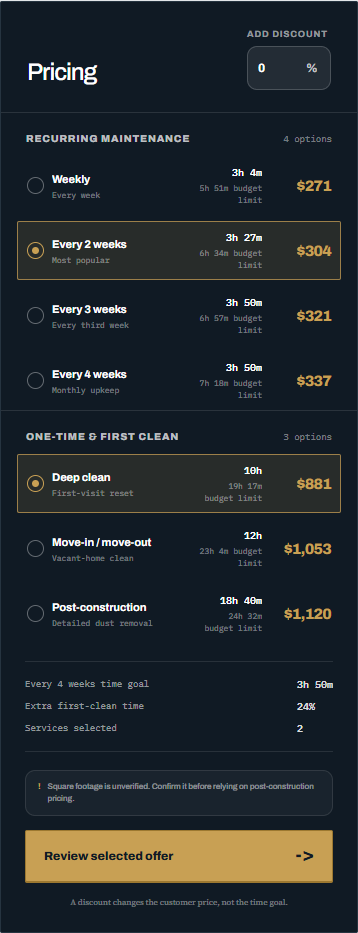
When she asks what weekly would cost instead of biweekly, you do not start over. It is already on the screen, with the labor goal next to it.
The calibration
We checked our own quotes against our own timesheets.
Every house we quote goes through this method. That is roughly 2,000 cleans a year, and it has been running that way for years. But "we use it constantly" is not evidence of anything, so at one point we sat down and audited it properly.
Pulling clean data is harder than it sounds. We went back through completed jobs and kept hundreds with timesheets we could actually trust, then compared the labor each quote allowed against the total crew labor the finished clean consumed. Not appointment length. Total crew hours off the timesheets.
A ratio of 1.00 means the clean took exactly the labor we allowed for it. Under 1.00 means it came in early. Over 1.00 means we gave the work away.
Half of our recurring cleans finished in less labor than the quote allowed. Three quarters landed within seven percent of it. The room based model held up.
Deep cleans ran worse, and we are showing you that on purpose. The whole distribution sits right of the goal line. First cleans carry more risk, which is exactly what every owner already suspects and no calculator will admit.
What we threw out before running it
- Commercial work
- Walkthroughs
- Turnovers and nonstandard jobs
- Missing or unreliable timesheets
- Ambiguous outliers
Every excluded row was kept for audit. Leaving messy data in would have made the result look better than it was.
Then we changed the product based on what we found. The subjective difficulty score came out, because it was the input people scored inconsistently. Observable first clean conditions went in, because a manager can see grease and hard water without having to guess a number.
We did not compare prices. We compared the labor we promised against the labor the job actually took, and we kept what held up.
The audit is the receipt. It is not the reason to trust the method. The reason to trust the method is that we still price every single house with it, thousands of times a year, in front of real customers and real crews who tell us immediately when a number is wrong.
Still in use
This is not a formula we invented to sell software.
It is the pricing system running inside our own residential cleaning company in North Carolina, a business approaching $400,000 in annual revenue that completes more than 2,000 cleans a year.
Every one of those jobs is a chance for the model to be wrong in public, in front of a customer and a crew. That is a harder test than any spreadsheet.
What actually changes
You still make the call. You just stop making it blind.
Before you say the number out loud, you can see how much labor the house should take, why the first clean costs more than the recurring service, and what the job earns per hour at the price you are about to offer.
When a customer pushes for a discount, you can see what the discount does to your effective hourly rate before you agree to it. When a house is genuinely strange, you override an explainable baseline instead of inventing the whole price from nothing. And when you finally hand quoting to a manager, you hand her a method instead of asking her to imitate your instincts.
The fair objections
Things you are probably thinking.
I already know how to price.
You probably do. Experienced owners develop real instincts, and we are not going to pretend otherwise. The problem with instinct is not accuracy. It is that you cannot audit it, explain it, repeat it under pressure, or hand it to somebody else. This makes your experience consistent and teachable.
Every home is different.
Correct, and that is the entire argument. That is why it inventories the actual rooms, separates used space from guest space, handles finished basements as real rooms, and flags the conditions you can see. Homes being different is the reason bedroom and bathroom shortcuts fail.
No calculator can know how long a house will take.
True. None can. What it can give you is a tested starting point you can explain, instead of an undocumented guess you cannot. The calibration numbers above are us being honest about exactly how close that starting point lands, including where it lands worse.
My market and my costs are different.
Your target hourly rate, minimums, travel load and cost assumptions are all yours to set. It ships with working defaults so you are not staring at an empty spreadsheet, and you change what does not fit your market.
I already have a CRM and a scheduler.
Keep them. This does not schedule, invoice, host your website or manage your customers. It prices homes. That is the entire job.
This sounds like too much to enter while I am estimating.
It is built for a phone in one hand. Use it during a customer call or at the property. Room counters, compact sections, live math. You enter what you know, then verify details when needed. It does the arithmetic.
Straight about where this is
No testimonials on this page yet.
Price Every Clean is in private preview. There are no paying customers to quote and no reviews to show you, so we are not going to manufacture any. What we can show you is where the method came from, how it was tested, and the fact that we still run our own company on it every day. Then you go price a real house and decide for yourself.
See the complete decision
Watch one home become a price, crew plan, and financial target.
Follow a prefilled residential cleaning estimate from room inventory through all seven recommendations, the crew handoff, and the job economics.
At the end, you can create a free account and price a real home yourself.
Start the interactive example- No account required for the example
- About three minutes from start to finish
- Seven prices and seven labor goals from one entry